Chicago’s top federal prosecutor said he serves at the pleasure of the president.
But Andrew Boutros didn’t take the traditional route to office. Nor did many of his peers. Rather, when President Donald Trump returned to the White House, he employed a law that eventually let federal judges appoint U.S. attorneys across the country — including Boutros.
That raises a critical question: Who gets to fire a judge-appointed U.S. attorney?
A West Coast legal fight might soon provide an answer. A 9th U.S. Circuit Court of Appeals panel in San Francisco spent nearly 90 minutes Friday considering whether to overrule a lower-court judge who concluded this month that “the president cannot unilaterally fire” such a prosecutor.
That judge got it wrong, Justice Department attorney Mark Freeman argued Friday. He said, “the power of a prosecutor is awesome. It brings the full power of the state against a citizen.
“That is why it is essential that the president be the one who can be blamed for it.”
But a U.S. attorney’s office is “supposed to be run by somebody who is confirmed by the Senate,” lawyer Donald Verrilli Jr. argued. That’s the judgment of Congress, he said, “and it is being evaded.”
The panel’s ruling will not be binding in Illinois. But it might offer guidance on a question that took on new relevance this summer. Local elected Democrats called on Boutros to resign after his office was accused of misconduct in a high-profile case tied to Operation Midway Blitz.
A judge is now considering whether to name a special prosecutor to investigate Boutros and others for criminal contempt. The controversy revolves around a now-defunct conspiracy case Boutros’ office brought against a group of Midway Blitz protesters known as “the Broadview Six.”
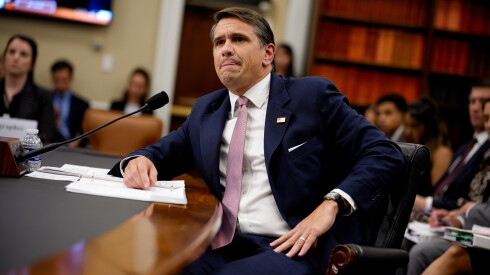
Then-Acting U.S. Attorney General Todd Blanche reacts to questioning during a House Committee on Appropriations hearing on June 2, when he told members the Trump Administration is abandoning plans for a $1.8 billion compensation fund intended to reward allies of the president.
Andrew Harnik/Getty Images
Attorney General Todd Blanche has said the Justice Department “fully supports U.S. Attorney Boutros.” Blanche made that comment before he was confirmed to his job on a permanent basis.
U.S. District Chief Judge Virginia Kendall has declined to comment on the controversy, citing the judicial code of conduct.
The West Coast case was heard Friday by Judges Richard Paez, appointed by President Bill Clinton; Jay Bybee, appointed by President George W. Bush; and Jennifer Sung, appointed by President Joe Biden.
It’s unclear how they’ll rule, or when.
Traditionally, U.S. attorneys are nominated by the president and confirmed by the Senate. That hasn’t happened in Chicago since 2017, when the Senate confirmed Trump nominee John Lausch.
Instead, then-Attorney General Pam Bondi appointed Boutros to the job on a temporary basis in April 2025. Then, when that appointment expired four months later, Chicago’s federal judges chose Boutros to continue on a more permanent basis, using the same law at issue out west.
The controversy has caught the attention of former top feds from across the country, including ex-Chicago U.S. Attorney Scott Lassar. He and others filed a brief opposing the Trump administration’s interpretation of the law.
Lawful appointments matter, they wrote, because a prosecutor’s decisions carry “life-changing consequences.”
It took Trump less than an hour to fire Roger Rogoff, named July 15 by judges in Seattle to be the top federal prosecutor there.
Shortly after he was sworn in, Rogoff learned by email that he’d been removed from the job — at the direction of the president.
Trump later sent the Senate a nominee for U.S. attorney, who has yet to be confirmed. The president also directed a former immigration judge to run the U.S. attorney’s office in the meantime.
Rogoff sued, arguing his dismissal by the president violated the law. On Oct. 1, U.S. District Judge Stanly Bastian agreed. In his preliminary injunction ruling, the judge posed the very question at issue: “Can the president fire a court-appointed U.S. attorney?”
Then, he answered it: “No.”
Bastian said that would “upend the framework created by the Constitution,” which balances the president’s right to appoint a prosecutor and the Senate’s right to confirm one.
“Allowing the president to fire a court-appointed U.S. attorney also eliminates the incentive to nominate a candidate that can be conferred by the Senate — in other words, bypassing the requirement that the executive and legislative branches work together to nominate and confirm the U.S. attorney,” Bastian wrote.
The law used to appoint Rogoff, Boutros and others allows the attorney general to name a U.S. attorney for 120 days. Then, if that appointment expires, it says the district court “may” appoint someone to that role.
Crucially, it says the court can appoint that person “to serve until the vacancy is filled.” That’s generally been taken as a reference to Senate confirmation of a presidential nominee.
“It does not say until that person is fired by the president,” Bastian pointed out in his order.
The Rogoff case is not the first to raise questions about the law.
The Justice Department’s initial attempt to prosecute former FBI Director James Comey fell apart when a judge ruled that Lindsey Halligan had not properly been appointed U.S. attorney in Virginia under the law.
But the question in the Comey case revolved around who gets to choose the U.S. attorney once the attorney general’s initial 120-day appointment expires. The Rogoff case turns on who can fire a judge-appointed U.S. attorney.
The Justice Department’s Freeman said a separate, but related, statute makes things clear.
It says, “each United States attorney is subject to removal by the president.”
Freeman argued in court filings that Bastian’s ruling was "indefensible."
It means a top federal prosecutor “may wield the core executive power of criminal law enforcement however he pleases — without accountability to anyone, without risk of removal for any cause, and without regard to whether he is insubordinate, corrupt, incompetent, or malfeasant — for the foreseeable future, unless the Senate agrees to confirm a replacement,” Freeman and his colleagues argued.
Verrilli reminded the appeals panel that no one forced the president to use the law.
“The president makes a choice,” Verrilli said. “A voluntary choice to gain the benefit of [the law] and the fact that he can basically put anybody he wants in the office for that interim period. But it comes with a constraint. The president opts into the constraint.”
The judges asked Freeman and Verrilli about prior court rulings and the practical implications of their arguments, including whether judges may remove the prosecutors they appoint.
Along the way, Verrilli acknowledged for Judge Bybee that a judge-appointed prosecutor has the same power as one confirmed by the Senate.
“Your contention is that he just can’t be removed under [the law] even though he is identical in authority, power and title?” Bybee asked.
That’s correct, Verrilli argued. Otherwise, the framework of the law has “basically unraveled,” he said.
“Congress made a judgment,” he told the panel, “that this is an office that should be subjected to the advice and consent power.”