
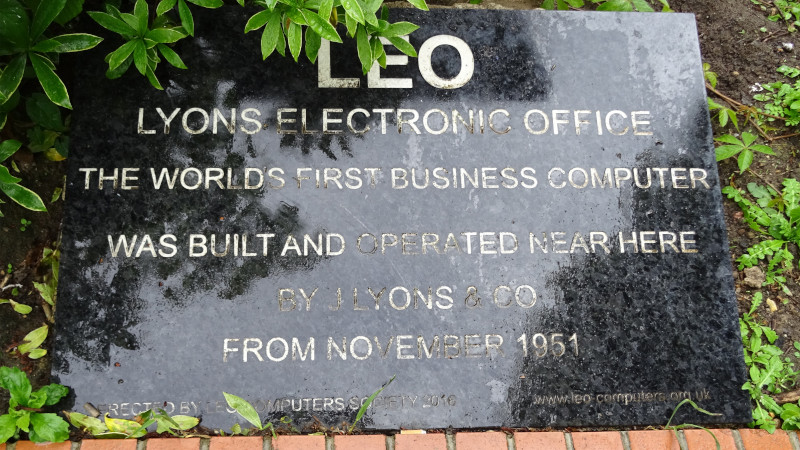
Many of us will have followed the early history of electronic computing, from the urgent necessities of war, to universities, and then on into the wider world. Most of the firsts in that field are now well known, but there’s one that’s a little obscure. LEO was a commercial development of Cambridge University’s EDSAC that was produced at the behest of J. Lyons and Comapny, one of the UK’s largest mid-20th-century food producers. As such it was the first purpose-built electronic business computer, and since its 75th anniversary is upon us, the Centre for Computing History is holding an event to mark the occasion.
There’s a whole cultural essay to be written about the role of Lyons in twentieth-century Britain, but for Hackaday purposes it should suffice to say that there was little in the way of food production that they didn’t touch. The shops were full of Lyons cakes, biscuits, and tea, and a feature of many towns would have been a Lyons Tea Shop, a budget restaurant. The logistics of such a complex business made a computer of great interest to the company, and after some of its executives learned about ENIAC on a trip to the USA they sought out a machine closer to home. They found the EDSAC, a research computer, and commercialised it as Lyons Electronic Office, or LEO. This spawned a series of machines that lasted into the 1970s, the last one being used by the British Post Office.
It might be difficult to find a LEO in a museum today, but in the National Museum of COmputing at Bletchley you can find the next best thing in their recreation of EDSAC. It’s a decade since we visited, perhaps it’s time for a return.
Header image: Spudgun67, CC BY-SA 4.0.


